How Much Does a Mobile Notary Cost? A Vista Notary Breaks Down Every Fee
I'm Devin Camm, owner and principal notary of Notary Drive, a mobile notary service based in Vista serving North County San Diego. Pricing is the first question on almost every call I take, so here is the full answer: the same breakdown I give clients on the phone, with real numbers, a story about a quote that taught me a lesson, and the red flags I'd watch for if I were hiring a notary myself.
The short answer: two parts to every mobile notary price
California mobile notary pricing has two parts.
The first part is set by law. Under California Government Code Section 8211, a notary may charge no more than $15 per notarized signature. That cap is the same whether the document is a one-page affidavit or page 87 of a living trust. That cap is changing: AB 1597 was signed into law on June 30, 2026 and raises the maximum to $20 per signature starting January 1, 2027. Until then, the limit is $15.
The second part is the travel and service fee, which is not regulated. This is where quotes vary between providers, and where the surprises hide if a company isn't upfront. At Notary Drive, travel is a flat fee by zone, disclosed in writing before I ever get in the car.
So a typical two-signature appointment at a home in Vista looks like this: $30 in statutory notary fees (two signatures at $15) plus a $50 core-zone travel fee, for an $80 total, quoted in writing before dispatch, assuming no rush-hour, after-hours, or other surcharges apply (see the full list below).
Quick answer: A standard two-signature mobile notary appointment in Vista costs about $80 — $30 in state-capped notary fees plus a $50 flat travel fee, quoted in writing before dispatch.
What the travel fee actually pays for
Most people assume the travel fee is just gas money.
The travel fee covers travel and scheduling, yes, but most of the value is in the screening that happens before I ever knock on your door. On the intake call I'm checking the document with you, confirming what type of notarization the paperwork calls for, catching missing pages and empty blanks, and confirming every signer has acceptable ID. That pre-work is the hardest part of the job. The notarization itself is usually the fastest part of the appointment: I check IDs, we sign the necessary parts of the document, I complete the certificate, stamp it, and log the required entries in my journal.
People are often intimidated by the process. They don't need to be. If the intake was done right, the appointment at your kitchen table is calm and quick, and that's what you're paying for.
How I build a mobile notary quote
Every quote starts with an intake call, and I follow the same script every time:
Your name, and a callback number in case we get disconnected
What city you're in. This is the single biggest factor in your price
Your timeline: when do you need this signed?
What the document is and what it's being used for
Who prepared it, whether an attorney, a bank, or an employer, in case we need to confirm details
A word-for-word read of the notary section at the end of the document, so I can identify whether it calls for an acknowledgment or a jurat
Whether there are blanks that still need to be filled in, and whether anyone has already signed
How many people are signing, whether everyone will be present, and whether each signer has current government-issued ID
If the document doesn't specify which notarial certificate it needs, I don't guess and I don't choose for you. California notaries can explain the options but can't select the act or give legal advice. I'll offer to stay on the line while you call the document preparer, or we revisit it before booking.
After the call, you get a written, itemized quote by text or email: the service address, the number of signers, the statutory notary fees, and the travel fee, added up to one total. You accept it, I book it. Nothing is dispatched on a verbal "it'll probably be around sixty bucks."
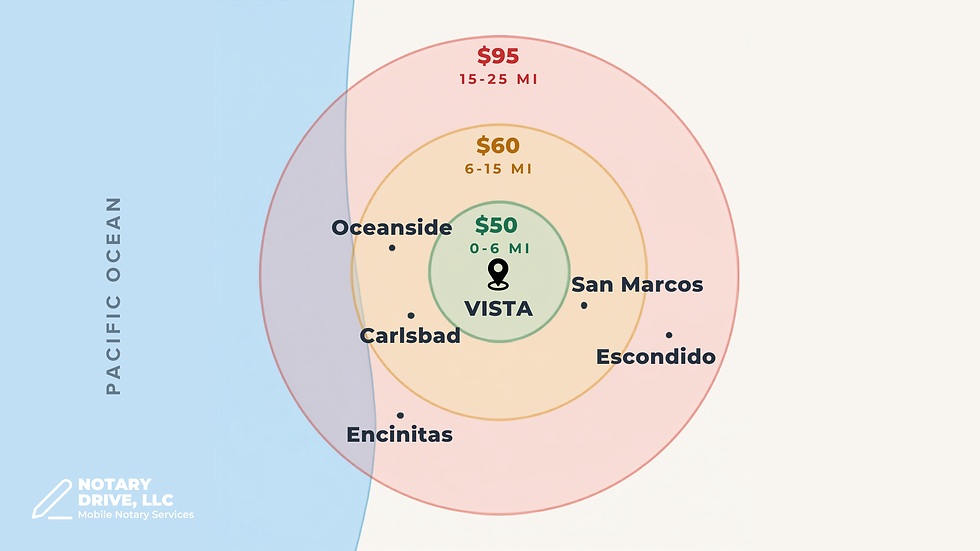
Travel fees by zone in North County San Diego
Notary Drive uses three flat travel zones measured out from central Vista, instead of per-mile math that changes after you book:
One travel fee covers the whole visit. Whether you have one signature or ten, you pay the travel fee once and then the per-signature statutory fee for each notarization.

Other fees that can appear on a quote
Every one of these is disclosed on the written quote before you accept, never discovered on arrival:
Fee | Amount |
Rush hour (5:00 to 7:00 PM on the SR-78/76 corridors) | +$25 |
After-hours (7:00 to 11:00 PM) | +$50 |
Late-night (11:00 PM to 6:00 AM, deposit required) | +$125 |
Sunday or holiday appointments | +$25 |
Same-day or emergency booking, less than 24 hours notice | +20% |
Document printing | $10 per 25-page block |
Secure scan-backs with a 2-hour return | $10 per 25-page block |
Scan-backs over 50 pages | +$25 on top of the per-block fee |
Courier drop to a FedEx/UPS hub | $15 |
Witness sourcing | $85 per witness |
Two things you will not find on a Notary Drive quote: waiting-time charges (I don't bill you because it took a minute to answer the door or you needed a moment with a page) and surprise line items added after I arrive.
Cancellation is free with 24 hours notice. Inside 24 hours it's $35, and if an appointment falls apart on-site, from an expired ID or an unwilling signer, the travel-zone fee plus the first signature fee applies. That's why the intake call works so hard to catch those problems before anyone drives anywhere.
The estate binder that taught me a pricing lesson
A client called about notarizing a trust her attorney had prepared for her and her husband. She flipped to the end of the document, counted four signature lines, and I gave her a preliminary estimate on that basis. She was thrilled, since she'd expected the total to run hundreds of dollars more.
Then she went through the binder page by page with her attorney. It wasn't a single trust document. It was a comprehensive estate package: the trust, wills, powers of attorney, health care directives, and a quitclaim deed. The signature count more than doubled, and because real estate deeds and powers of attorney also require a journal thumbprint in California, the appointment scope grew with it. The revised statutory fees alone were far beyond her original expectation. I waived a service fee to help close the gap, but the final quote was more than she had budgeted, and I understood.
Two lessons came out of that call, and both are now baked into how I quote. First, I audit the exact signature count before sharing any estimate. "How many signatures are at the end" is not the same as "how many notarizations are in the binder." Second, for large estate planning packages, Notary Drive can cap the total at a flat project rate rather than letting the per-signature math run away. If you're executing a full estate binder, ask about project capping when you call.
Hospital and jail notary appointments are priced differently
Notary Drive prices facility work as flat packages so families aren't watching a meter during a hard week:
Facility appointment | Flat rate |
Hospital or skilled nursing bedside, weekday | $129, including travel and the first notarization |
Hospital or skilled nursing bedside, urgent evening or weekend | $179 |
Vista Detention Facility | $149, including travel, secure entry, up to an hour of table time, and up to two signatures |
The flat rate reflects what these visits actually involve. At a hospital it's parking, finding the right medical tower, checking in at the nursing station, protective gear, and working around physician and nursing rounds. At the jail it's security check-ins, article searches, and waiting through inmate head counts and escorts. It can take 45 to 90 minutes before the signer even reaches the table.
Facility appointments require extra pre-screening because access, signer awareness, ID, and document readiness can affect whether the notarization can proceed. Before dispatch, we confirm the signer is present, alert, and willing; that ID meets California requirements; that the document is complete; and that the facility allows access. A deposit applies to bedside and detention bookings, and on completion it credits in full toward your total.
When paying for a mobile notary is worth it
There are cheaper options. A shipping store charges little, and some banks notarize for customers at no charge. I'm honest with callers about that. Here's when mobile makes sense:
The signer can't travel, because they're in a hospital bed, a senior living facility, or a detention facility
You need evening, weekend, or urgent service. Many walk-in counters close early on Saturday and are closed Sunday
The document is high-stakes or long. A 100-plus-page estate package signed at a retail counter, with a line forming behind you, is a stressful way to execute very important paperwork
You want pre-screening. Walk-in notaries rarely review your document in advance, check for missing pages, or confirm the certificate type before you show up
I've watched the walk-in scenario go sideways: two employees in the store, one of them is the notary, it's rush hour, and your signing keeps pausing so they can ring up customers. Everyone is doing their best, but a notarization deserves someone's full attention. That's the service you're buying.
Red flags when you're comparing notary quotes
Opinions ahead, earned the hard way. When you're comparing services in North County, watch for these:
The teaser price. An "$11 mobile notary" headline that turns into a $50 to $95 travel or "reservation" fee announced at your door. California's SB 478 honest-pricing law exists because of pricing like this. The quote you accept should be one total with the fees itemized inside it.
Per-page pricing. California caps the fee per notarized signature, not per page. A 20-page power of attorney with one signature block should not cost hundreds of dollars because the document "looks important."
Fine-print surcharges. Aggressive waiting-time meters, mandatory card-processing add-ons, and $50 to $75 "failed trip" fees triggered by things as small as taking a moment to answer the door.
No written quote. If a provider will only say "probably fifty or sixty, we'll figure it out when I get there," keep looking. A legitimate service puts the total in writing before dispatch.
Travel math that moves. A homepage advertising a flat travel fee, with a per-mile rule buried elsewhere that quietly rewrites your total.
A fair quote is simple to recognize: it's written, it's itemized, it separates the state-capped notary fees from the travel and service fees, and it's delivered before anyone is dispatched.
How to keep your notary cost down
Batch your documents. The travel fee is paid once per visit, so knock out the auto title, the affidavit, and the estate paperwork in one appointment instead of three trips over three weeks.
Confirm the certificate type before booking. If the notary wording at the end of your document is unclear, ask the preparer whether it needs an acknowledgment or a jurat. That keeps your notarization valid and saves you a second appointment.
Schedule smart. A weekday appointment outside the 5:00 to 7:00 PM rush window avoids the timing surcharges entirely.
Ask about group signings. If your HOA, office, or community has several people signing similar documents, one visit with a shared travel fee can serve everyone. A colleague of mine set up a table at an HOA meeting and notarized for a whole line of homeowners in one sitting. That model works.
Who's answering your call
Notary Drive is owner-operated. I'm commissioned as a California notary public, with my oath and bond filed with San Diego County, a surety bond and E&O insurance in place, and NNA Certified Notary Signing Agent status with a completed background screening. My fingerprints have been cleared through the California DOJ and the FBI.
Before this, I spent years in retail asset protection, where the job was identity verification and documentation that had to hold up to review, and I hold a Bachelor of Science in Criminal Justice Administration from San Diego State University. That background shows up in every appointment: check identity carefully, follow the procedure exactly, document everything. Every notarization goes into a sequential journal as California law requires, backed by a recordkeeping system built so any appointment can be reviewed later with a clear paper trail.
One boundary worth stating plainly: a notary verifies identity and witnesses signatures. I can explain the notarization process, but I can't give legal advice or choose the notarial certificate for you, and if legal requirements aren't met, a notarization may be refused. That's the law protecting your document.
Mobile notary cost FAQs
How much does a mobile notary cost in California?
Two parts. California caps the notary fee at $15 per notarized signature through December 31, 2026, rising to $20 on January 1, 2027 under AB 1597. The mobile travel and service fee is not regulated and is set by each provider. At Notary Drive, travel starts at $50 in the Vista core zone, so a typical two-signature home appointment runs $80 total.
Is the $15 notary fee per page or per signature?
Per notarized signature. A 20-page power of attorney with one signature block carries one $15 statutory fee, not one per page. Any provider charging per page is not following the state fee structure.
What does a mobile notary charge for travel in North County San Diego?
Notary Drive charges $50 in Vista (0 to 6 miles), $60 in Oceanside, Carlsbad, and San Marcos (6.1 to 15 miles), and $95 in Escondido and Encinitas (15.1 to 25 miles). Anything past 25 miles is quoted individually. One travel fee covers the whole visit no matter how many signatures.
How much does a hospital or bedside notary cost?
Notary Drive charges a flat $129 on weekdays and $179 for urgent evening or weekend bedside visits, including travel and the first notarization. The flat rate covers parking, check-in, protective gear, and waiting through medical rounds.
How much does a jail notary cost in Vista?
$149 flat for the Vista Detention Facility, including travel, secure entry, up to an hour of table time, and up to two signatures. Security check-ins, article searches, and inmate head counts can take 45 to 90 minutes before the signer reaches the table.
Can I get a mobile notary quote in writing before booking?
Yes, and you should insist on it. Notary Drive sends a written, itemized quote by text or email showing the service address, number of signers, statutory notary fees, and travel fee as one total. Nothing is dispatched on a verbal estimate.
Do you charge waiting-time fees?
No. Notary Drive does not bill waiting time, and no line items are added after arrival.
Get your written quote
Notary Drive is a mobile, service-area business. We come to you across Vista, Oceanside, Carlsbad, San Marcos, Escondido, and Encinitas.
Request a quote or book online, or send a text with your city, the document type, the number of signers, and your preferred time. You'll get a written, itemized total before anything is booked.
You're not paying for a stamp. You're paying for a mobile visit with no surprises, from someone whose whole process is built to get your legal paperwork done right the first time, wherever you are.
California notary fees are set by law per notarized signature. Travel, printing, after-hours, and facility-related fees are quoted separately and disclosed before dispatch. This article is general information, not legal advice.


Comments